
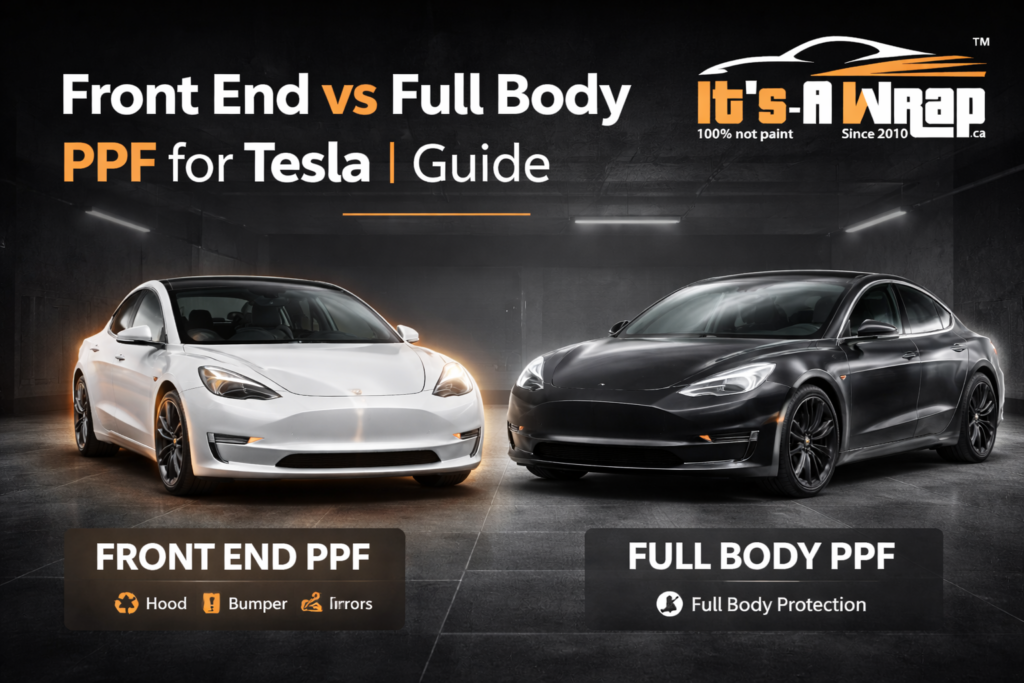
Both use Paint Protection Film to create a physical barrier between your Tesla’s paint and everyday damage, but they protect very different amounts of the vehicle—and come at very different price points.
At It’s aWrap™, we’ve spent more than 15 years protecting vehicles in Mississauga and the GTA, and Teslas are among the most common vehicles we work on. In this guide, we’ll compare front-end vs full-body PPF for Tesla based on coverage, driving habits, Ontario conditions, ownership plans, and budget.
Why PPF Is So Popular With Tesla Owners in Ontario
Teslas driven in Southern Ontario encounter the same stone chips, gravel, winter debris, road salt, construction material, and highway contamination as every other vehicle. What makes PPF particularly popular with Tesla owners is the combination of exposed painted surfaces and the amount of highway driving many GTA owners do.
Areas such as the front bumper, hood, fenders, mirrors, rocker panels, and lower doors can all experience wear depending on the model and driving conditions.
We cover these factors in greater detail in our guide to Tesla paint chips in Canada.
What Is Front-End PPF?
Front-end PPF concentrates protection on the panels most directly exposed to stones and road debris.
A full-front package typically protects areas such as:
- Full front bumper
- Full hood
- Full front fenders
- Mirror caps
- Headlights, depending on the package and vehicle
Additional areas such as A-pillars, rocker panels, or lower doors can also be protected separately when appropriate.
The advantage is straightforward: instead of paying to cover the entire vehicle, you’re putting PPF where direct road impacts are most likely to occur.
Who Is Front-End PPF Best For?
Front-end PPF is usually the best value for Tesla owners who:
- Want protection against the most common stone-chip damage
- Regularly drive on the 401, 403, QEW, 407, or other GTA highways
- Want meaningful protection without the cost of wrapping every painted panel
- Lease their Tesla or expect a shorter ownership period
- Are primarily concerned about keeping the front of the vehicle clean
For many daily-driven Model 3 and Model Y vehicles, this is the coverage level that provides the strongest balance between protection and cost.
What Is Full-Body PPF?
Full-body PPF extends that physical protection across virtually all exterior painted panels.
Depending on the vehicle and installation, coverage can include:
- Front bumper
- Hood and front fenders
- Doors
- Quarter panels
- Rocker panels
- Rear bumper
- Trunk or hatch
- Exterior pillars and other painted surfaces
This means protection isn’t limited to areas facing forward. Door scuffs, minor scratches, parking-lot contact, road contamination, and wear on lower body panels are also less likely to reach the factory paint underneath.
Who Is Full-Body PPF Best For?
Full-body coverage makes more sense if:
- You plan to keep your Tesla for many years
- Maintaining the original paint condition is a high priority
- You drive substantial annual mileage
- Your vehicle is exposed to Ontario winters year after year
- You want protection beyond stone chips on the front end
- You own a higher-value vehicle and want more comprehensive coverage
It costs considerably more than front-end PPF, so it isn’t automatically the right choice for every Tesla owner.
Front End vs Full Body PPF: Side-by-Side Comparison
| Factor | Front-End PPF | Full-Body PPF |
|---|---|---|
| Front stone-chip protection | Excellent | Excellent |
| Side and rear panel protection | Limited | Excellent |
| Rocker panel protection | Optional | Typically included |
| Protection from minor scratches and scuffs | Protected front panels only | Across most painted panels |
| Original paint preservation | Focused on high-impact areas | Most comprehensive |
| Cost | Lower | Higher |
| Best suited for | Value-focused protection | Maximum long-term protection |
What About Partial Front PPF?
There is also a third option that sometimes gets overlooked: partial front protection.
Partial packages can protect selected high-impact areas without covering the entire hood and fenders. This provides a lower entry price, but unlike a full-front installation, the edge of the film may be visible where coverage ends on a panel.
For customers prioritizing appearance as well as protection, we generally prefer full-panel coverage where budget allows. But partial coverage can still make sense when the primary goal is protecting the most vulnerable areas at a lower cost.
Which PPF Coverage Is Best for the Tesla Model 3 and Model Y?
Model 3 and Model Y vehicles are among the Teslas we protect most frequently.
For a typical Ontario daily driver, full-front PPF is an excellent starting point. It protects the bumper, hood, fenders, and mirrors—the areas most exposed to direct highway debris.
For higher-mileage vehicles, particularly Model Ys driven throughout winter, extending protection to the rocker panels and lower doors can also make sense.
Owners who plan to keep the vehicle long-term and want protection from scratches and wear across the rest of the body may prefer full-body coverage.
What About the Model S and Model X?
The same decision applies to Model S and Model X owners, but vehicle value and ownership expectations can make full-body protection more attractive.
If the main concern is highway stone chips, front-end PPF remains effective. If preserving as much of the original finish as possible is the objective, full-body PPF provides significantly broader coverage.
Does the Cybertruck Need PPF?
The Cybertruck is different because its exterior uses exposed stainless-steel panels rather than a conventional painted body.
That means the front-end-versus-full-body paint-protection decision doesn’t apply in exactly the same way.
Cybertruck owners may instead choose a colour-change wrap or protective film to alter the appearance, simplify maintenance, or add a sacrificial surface over the stainless steel.
How Your Driving Habits Should Influence Your Decision
When customers ask us which package they should buy, one of the first things we consider is how they actually use the vehicle.
Consider Front-End PPF If:
- Your main concern is stone chips
- You want the strongest protection-per-dollar
- You regularly commute on GTA highways
- You don’t mind the remaining panels being unprotected
- You have a defined protection budget
Consider Full-Body PPF If:
- You want protection across virtually the entire painted exterior
- You plan to keep your Tesla long-term
- You are particular about scratches and cosmetic wear
- You drive the vehicle year-round
- You want to preserve as much of the factory finish as possible
What About Rocker Panels?
This is one area where the choice doesn’t always have to be strictly front-end versus full-body.
If you want more protection than a standard full front but don’t want to invest in full-body PPF, adding rocker-panel or other targeted coverage can be an excellent middle ground.
Lower sections of the vehicle are exposed to debris thrown by the tires, winter slush, road contamination, and everyday wear. Extending PPF to these areas allows us to tailor the package to your actual driving conditions.
Can You Ceramic Coat PPF?
Yes. PPF and ceramic coating perform different jobs and can work extremely well together.
PPF provides the physical impact protection. Ceramic coating adds hydrophobic properties that can make the protected surfaces easier to wash and maintain.
Ceramic coating should not be viewed as a substitute for PPF if your primary concern is stone chips.
Tesla Protection Packages at It’s aWrap™
Rather than treating every Tesla owner the same, we offer several packages based on different protection goals and budgets.
- Tesla Standard PPF – entry-level protection for vulnerable areas
- Tesla Cruiser – full front-end PPF combined with window tint and ceramic coating
- Tesla Ranger – full-body PPF combined with additional protection services
- Tesla Transformer – colour-change wrap package for owners focused on transforming the vehicle’s appearance
- Cyber Transformer – wrap package designed specifically for the Cybertruck
Package pricing and inclusions can change, so rather than hard-coding prices into this guide, you can view our current Tesla PPF, wrap and tint packages for the latest options.
So, Is Front-End or Full-Body PPF Better?
Neither option is universally better. The better choice depends on what you’re trying to protect.
If stone chips are your primary concern and you want the most efficient use of your budget, full-front PPF is usually the better value. You’re protecting the surfaces that take the majority of direct road impacts without paying to cover panels that see much less impact exposure.
If you want comprehensive protection against chips, minor scratches, scuffs, and everyday wear across the vehicle—and you’re planning to keep your Tesla for years—full-body PPF provides the more complete solution.
There is also nothing wrong with choosing something in between. Full-front PPF combined with rocker-panel or other targeted coverage can be an excellent setup for an Ontario daily driver.
Final Thoughts
The question isn’t simply whether full-body PPF provides more protection—it obviously does. The real question is whether you need that additional protection enough to justify the additional investment.
For many Tesla owners in Mississauga and the GTA, full-front PPF provides the sweet spot between cost and protection. For long-term owners who want to preserve virtually every painted surface, full-body PPF is difficult to beat.
If you’re unsure which level makes sense for your Model 3, Model Y, Model S, or Model X, explore our Tesla protection packages or contact our Mississauga team. We can recommend coverage based on your vehicle, mileage, driving habits, and budget rather than simply recommending the most expensive option.