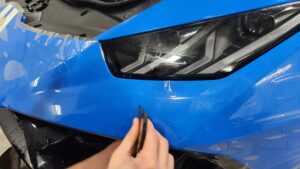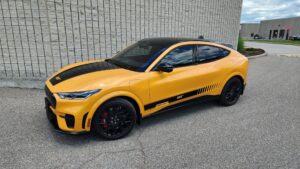
Both can completely transform the appearance of a car without permanently repainting it, but they are not interchangeable products.
Vinyl wrap is primarily a styling material. It gives you an enormous range of colours and finishes at a lower cost.
Coloured PPF combines styling with meaningful physical paint protection. It costs more, but its urethane construction is designed to help absorb stone chips, road debris, scratches, and other everyday impacts.
So which one should you choose?
The answer depends on what matters more to you: maximum colour choice and lower cost, or colour change and stronger paint protection in the same product.
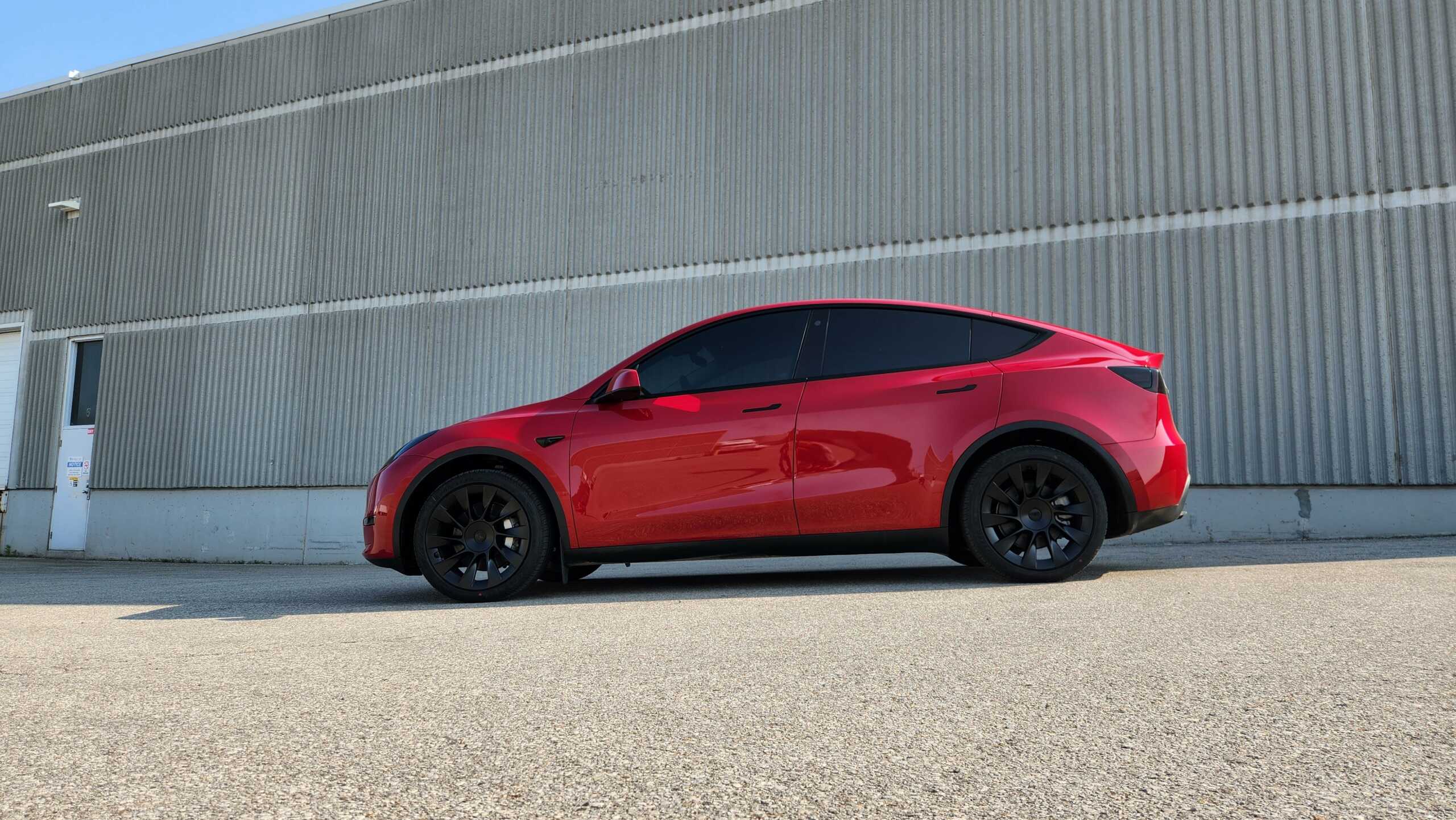
What Is Coloured PPF?
Coloured Paint Protection Film is a protective urethane film that changes the colour or finish of a vehicle while protecting the original paint underneath.
It builds on the same basic concept as traditional clear PPF but adds an opaque colour or visual effect.
Depending on the specific film, coloured PPF may offer:
- Stone-chip protection
- Resistance to light scratches and surface abrasions
- Self-healing topcoat technology
- Resistance to environmental contamination
- Gloss, satin, matte, metallic, pearl, and speciality finishes
At It’s aWrap™, we work with coloured PPF options from manufacturers including 3M, Pure PPF, and SVG, depending on the colour, finish, vehicle, and customer’s goals.
You can explore the category in more detail on our coloured PPF service page.
What Is a Vinyl Wrap?
Automotive vinyl wrap is a thin, flexible film primarily designed to change the appearance of a vehicle.
It is available in an enormous variety of:
- Gloss colours
- Matte finishes
- Satin finishes
- Metallics
- Pearls
- Colour shifts
- Textures
- Printed graphics
- Speciality finishes
Vinyl covers the original paint and provides a sacrificial surface against some light contamination and everyday contact, but it should not be treated as dedicated stone-chip protection.
At It’s aWrap™, 3M and KPMF are our primary choices for automotive colour-change wraps.
You can see our current car wrap options for full colour changes and custom finishes.
Coloured PPF vs Vinyl Wrap at a Glance
| Feature | Coloured PPF | Vinyl Wrap |
|---|---|---|
| Primary Purpose | Colour change + paint protection | Colour change and styling |
| Stone-Chip Protection | Designed for physical impact protection | Limited |
| Colour Selection | Growing rapidly | Typically much broader |
| Speciality Finishes | Available but product-dependent | Very broad selection |
| Self-Healing | Common on many premium films | Not a standard feature |
| Material | Protective urethane film | Automotive vinyl |
| Cost | Higher | Lower |
| Best For | Owners wanting styling and protection together | Owners primarily focused on appearance |
1. Paint Protection: Coloured PPF Wins
If physical paint protection is important to you, coloured PPF has the clear advantage.
The urethane film is specifically engineered to help protect against hazards such as:
- Stone chips
- Road debris
- Light scratches
- Minor abrasions
- Bug residue
- Road salt and grime
Vinyl wrap can take some minor surface contact before it reaches the paint, but that is a secondary benefit rather than its primary purpose.
A sufficiently sharp stone can cut through vinyl and damage the paint underneath.
If you’re specifically interested in the scratch and impact differences, our vinyl wrap vs PPF scratch-resistance guide goes deeper into that comparison.
2. Colour Selection: Vinyl Wrap Wins
Vinyl still has a major advantage when it comes to sheer variety.
Automotive wrap manufacturers have spent decades building colour catalogues covering virtually every visual direction imaginable.
You can find:
- OEM-inspired colours
- Bright solid colours
- Metallics
- Pearls
- Pastels
- Colour-shifting films
- Matte and satin finishes
- Textures and speciality effects
Coloured PPF choices have expanded considerably, but the catalogue is still generally smaller than the vinyl market.
If you have an extremely specific colour in mind, vinyl may simply give you more options.
3. Cost: Vinyl Wrap Is Usually More Affordable
For a full colour change, vinyl is generally the less expensive route.
Coloured PPF costs more because you’re paying for a substantially different material whose purpose includes physical paint protection.
The correct comparison isn’t simply:
“Which one is cheaper?”
It’s:
“Am I willing to pay more because I also want PPF-level protection?”
If protection doesn’t matter much to you, paying the premium for coloured PPF may not make sense.
If you were already considering full-body PPF and also wanted to change the vehicle’s colour, coloured PPF becomes much easier to justify.
4. Appearance: Neither Product Automatically Wins
A common misconception is that coloured PPF always looks more like paint or that vinyl always looks obviously wrapped.
The real result depends heavily on:
- The specific film
- Colour
- Finish
- Vehicle shape
- Installation quality
- Edge finishing
- Lighting
Premium vinyl can produce an excellent colour-change finish.
Premium coloured PPF can also produce impressive gloss, depth, satin, and matte effects.
The best approach is to compare physical samples rather than deciding based purely on the material category.
5. Gloss, Matte and Satin Are Available in Both
You aren’t restricted to gloss simply because you choose PPF.
Both product categories can offer:
- Gloss
- Matte
- Satin
- Metallic
- Speciality finishes
However, the available colours vary considerably between manufacturers.
A colour you love may exist only as vinyl, while another may be available as coloured PPF.
That is why we recommend choosing the actual colour and finish, not simply deciding on a material before looking at the available films.
6. Self-Healing: PPF Has the Advantage
Many modern premium PPF products use self-healing topcoats designed to reduce the appearance of light surface marks when exposed to warmth.
This is not the same as saying the film repairs every scratch.
Self-healing typically applies to:
- Very light scratches
- Fine wash marks
- Minor surface abrasions
It does not repair punctures, deep cuts, tears, or severe impact damage.
Traditional automotive vinyl should not generally be assumed to have this capability.
7. Longevity Depends on the Actual Product
It’s tempting to say coloured PPF lasts exactly ten years while vinyl lasts exactly three to five, but that oversimplifies both categories.
Actual service life depends on:
- Manufacturer
- Specific film line
- Film colour
- Finish
- Vehicle storage
- UV exposure
- Climate
- Horizontal vs vertical panels
- Maintenance
- Installation quality
Some products also have different warranty terms depending on the film and application.
Rather than buying based on a generic lifespan claim, review the warranty and expected performance of the specific material being installed.
8. Maintenance Is Similar, but Finish Matters
Both coloured PPF and vinyl benefit from careful washing.
For either material:
- Use appropriate automotive shampoo
- Use clean, soft wash media
- Avoid aggressive brush washes
- Remove bird droppings, sap, and insects promptly
- Avoid harsh chemicals unless confirmed compatible
The finish can matter as much as the material itself.
Gloss surfaces may show water spots and fine marks under certain lighting, while matte or satin films require products that don’t create uneven glossy patches.
9. Ceramic Coating Can Be Used With Either
A compatible ceramic coating can often be applied over vinyl or coloured PPF.
Its role is primarily to improve surface behaviour rather than impact protection.
Depending on the coating and underlying film, benefits can include:
- Better water behaviour
- Easier washing
- Reduced contamination adhesion
- Gloss enhancement on compatible finishes
Ceramic coating does not turn vinyl into PPF and should not be treated as a substitute for impact protection.
If easier maintenance matters to you, explore our ceramic coating options.
10. Full-Body Coverage Makes More Sense With Coloured PPF
Traditional clear PPF is frequently installed only on high-impact areas because the factory paint remains visible through the film.
Coloured PPF is different.
If the goal is changing the entire colour of the car, the film generally needs to cover most or all of the painted exterior.
That means coloured PPF commonly provides full-body protection across:
- Bumpers
- Hood
- Fenders
- Doors
- Quarter panels
- Rocker panels
- Roof
- Trunk or liftgate
- Mirrors
Vinyl colour changes are also generally full-body applications when the owner wants a complete transformation.
11. What About Door Jambs and the Original Paint Colour?
This is something owners often don’t think about until they see a completed colour change.
Whether you choose vinyl or coloured PPF, the original paint may remain visible in areas such as:
- Door jambs
- Deep panel gaps
- Engine-bay areas
- Interior door edges
- Other surfaces not included in the installation
The more dramatically different the new colour is from the factory paint, the more noticeable that contrast can become.
This should be discussed during the planning stage rather than discovered after installation.
12. Installation Is Different Even Though Both Are Films
A great vinyl installer is working with a different material behaviour than a PPF installer.
Both require experience with:
- Surface preparation
- Stretch
- Body contours
- Edges
- Seams
- Disassembly
- Reassembly
- Panel transitions
But PPF and vinyl don’t install identically.
Coloured PPF combines the visibility of a full colour-change installation with the installation characteristics of protective urethane film, which makes installer experience particularly important.
13. Existing Paint Condition Matters for Both
Neither vinyl nor coloured PPF repairs damaged paint.
Before installation, the vehicle should be inspected for:
- Failing clear coat
- Peeling paint
- Deep scratches
- Stone chips
- Previous body repairs
- Repainted panels
- Contamination
Unstable or poorly repaired paint can create problems during installation or eventual removal.
Film looks best when the surface underneath is properly prepared and structurally sound.
14. Both Are Removable, but Paint Condition Matters
One of the advantages of both products is that the colour change is reversible.
A professionally installed automotive film can later be removed to reveal the original finish underneath.
However, “removable” should not be interpreted as a guarantee that every film can be removed from every surface with zero risk.
Repainted panels, weak clear coat, previous repairs, film age, and improper installation can all influence removal.
Factory paint in healthy condition generally provides the best starting point.
15. Which One Is Better for Leased Vehicles?
Either can be appropriate, but the economics matter.
If you’re leasing for a relatively short period and mainly want a temporary colour change, vinyl may make more sense because of its lower upfront cost.
If you’re driving a higher-value leased vehicle extensively and want stronger protection as well as a colour change, coloured PPF may be worth considering.
Before applying either product, check any lease requirements that apply to vehicle modifications or return condition.
16. Which One Makes More Sense for a Daily Driver?
Daily drivers often experience the most road exposure.
If you commute extensively on highways, coloured PPF’s added impact protection can become valuable because the vehicle continually encounters:
- Loose stones
- Construction debris
- Winter aggregate
- Road salt
- Sand
But if the car is an ordinary daily driver and budget is the priority, a quality vinyl wrap can still make more financial sense for a colour change.
The fact that coloured PPF provides more protection doesn’t automatically mean every vehicle needs it.
17. Which Is Better for Luxury or Performance Cars?
Coloured PPF becomes particularly compelling when the owner already places a high value on preserving the factory paint.
This can include:
- Porsche
- BMW M
- Mercedes-AMG
- Corvette
- Tesla
- Luxury SUVs
- Exotic vehicles
- Enthusiast cars
On those vehicles, an owner considering a full colour change may already be thinking about full-body PPF.
Combining both objectives into coloured PPF can make more sense than installing vinyl and then trying to add protective film over selected areas.
Can You Put PPF Over Vinyl Wrap?
It can be done in certain applications, but it isn’t automatically the ideal way to achieve colour change plus protection.
The installer needs to consider compatibility between:
- The vinyl
- The PPF adhesive
- The underlying paint
- Future removal
You are also creating two separate film layers that may age differently.
If you’re starting from scratch and want full-body colour change plus impact protection, coloured PPF may provide the cleaner overall solution.
Can You Mix Coloured PPF and Vinyl on the Same Car?
Yes, when the design calls for it.
For example, a vehicle could use coloured PPF as the primary exterior finish while vinyl is used for:
- Stripes
- Accent graphics
- Logos
- Decorative elements
- Temporary styling changes
Compatibility and removal should still be considered before layering different products.
What If You Specifically Want 3M Coloured PPF?
3M is one of the coloured PPF manufacturers we offer.
If you’re already considering 3M and want to see how its coloured protective films fit into your project, visit our dedicated 3M coloured PPF page.
We wouldn’t recommend choosing purely by brand name, though.
The actual colour, finish, film specifications, warranty, vehicle, and desired result should all be part of the decision.
Choose Coloured PPF If…
- You want to change the vehicle’s colour
- Stone-chip protection is important to you
- You want full-body paint protection
- You’re willing to spend more for the added protection
- You plan to keep the vehicle long enough to value that protection
- The colour and finish you want are available in a suitable PPF product
Choose Vinyl Wrap If…
- Your main priority is appearance
- You want the largest possible colour selection
- You want a more economical full colour change
- You enjoy changing your vehicle’s look more frequently
- Stone-chip protection isn’t a major priority
- You want speciality colours or textures that aren’t available in coloured PPF
Don’t Choose Based on a Spec Sheet Alone
Both materials need to be seen in person.
A film that looks perfect online may look very different:
- In direct sunlight
- Under cloudy skies
- Under indoor lighting
- Across a full vehicle rather than a small swatch
- Against your wheels, trim, glass, and interior
Metallic, pearl, colour-shifting, satin, and matte finishes are particularly difficult to judge from photographs.
Whenever possible, compare physical samples and completed installations.
You can browse examples of our colour-change work in the It’s aWrap™ portfolio.
Frequently Asked Questions
Is coloured PPF better than vinyl wrap?
Not universally. Coloured PPF is the stronger option when paint protection and colour change are both priorities. Vinyl is generally better when colour selection, styling flexibility, and lower cost matter more.
Is coloured PPF more expensive than vinyl?
Generally, yes. Coloured PPF uses protective urethane film designed to provide substantially more physical protection than conventional colour-change vinyl.
Does vinyl wrap protect against stone chips?
Only to a limited degree. Vinyl can provide a sacrificial surface against some light contact, but it is not engineered to provide the same stone-chip protection as PPF.
Does coloured PPF come in matte and satin?
Yes. Coloured PPF is available in gloss, matte, satin, metallic, and other speciality finishes, although exact selections vary by manufacturer.
Can coloured PPF be removed like vinyl?
Yes. Automotive PPF is designed to be removable, but removal conditions depend on film age, installation, paint condition, and whether the vehicle has repainted panels.
Which lasts longer: PPF or vinyl wrap?
There is no single lifespan that applies to every product. Premium PPF often carries longer expected service life than many colour-change vinyl films, but actual longevity depends on the manufacturer, film, exposure, maintenance, storage, and installation.
Can I get clear PPF instead?
Yes. If you love your factory colour and simply want physical paint protection, conventional clear PPF is usually the more appropriate option.
Final Verdict: Coloured PPF or Vinyl Wrap?
The easiest way to choose is to identify what you’re actually paying for.
Vinyl wrap is the better starting point when your priority is customization. You get an enormous range of colours and finishes and a more economical way to completely transform the vehicle.
Coloured PPF is the better starting point when you want customization and serious paint protection together. You pay more, but the film is designed to protect against stone chips, road debris, scratches, and everyday impacts in a way vinyl is not.
Neither option is automatically right for every vehicle.
At It’s aWrap™, we install both, which means we can compare the products based on your actual priorities rather than trying to push every colour-change customer toward the same material.
Explore our coloured PPF options, compare them with our vinyl car wraps, or contact It’s aWrap™ to see available films in person.