Paint Protection Film has changed considerably over the years, but some of the advice surrounding it has not. We still hear drivers ask whether PPF will damage their paint, turn yellow, peel after a few years, or whether it is only worth installing on expensive vehicles.
After more than 15 years working with vehicle protection products at It’s aWrap™ in Mississauga, we’ve seen properly installed PPF age on daily drivers, luxury vehicles, Teslas, performance cars and work vehicles throughout Ontario.
Some concerns about PPF are legitimate. Others come from older generations of film, poor-quality products or bad installations. Here are some of the most common PPF myths we hear — and what vehicle owners should actually know.
Myth #1: PPF Will Damage Your Car’s Paint
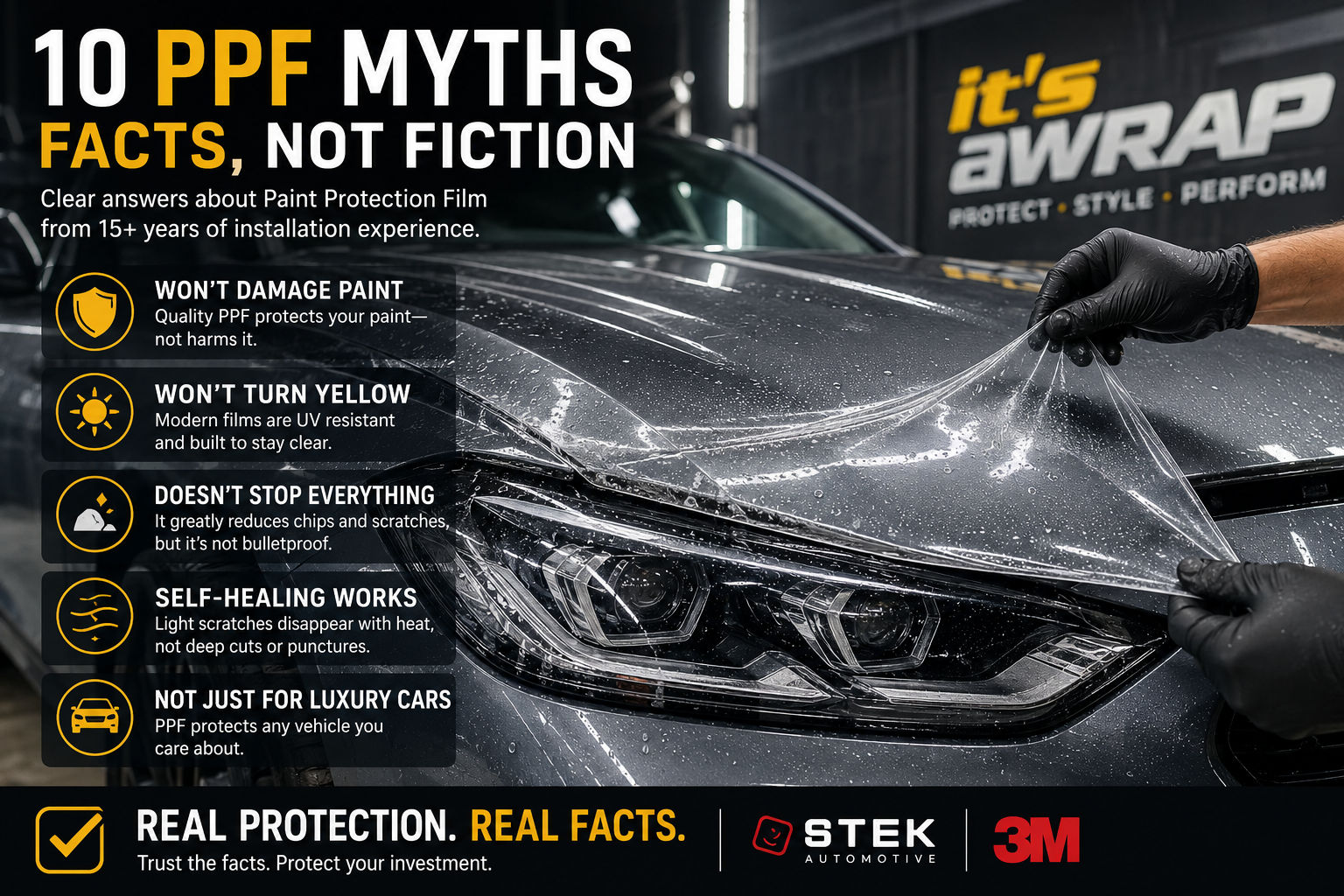
The reality: Quality PPF installed and removed correctly should not damage healthy factory paint.
Modern automotive PPF uses an adhesive system designed specifically for painted vehicle surfaces. On intact OEM paint, professionally installed film can generally be removed without harming the finish underneath.
There is an important exception: the condition and history of the paint matter.
If a panel has been poorly repainted, has failing clear coat, or already has adhesion problems, removing any adhesive film can carry additional risk. That is one reason we inspect the vehicle before installation rather than treating every painted surface the same way.
For drivers considering PPF, our Paint Protection Film services in Mississauga explain the different protection and coverage options available.
Myth #2: All PPF Eventually Turns Yellow
The reality: Yellowing was a much bigger problem with older films and remains more of a concern with low-quality products.
Modern premium PPF has improved considerably in optical clarity, UV stability, stain resistance and top-coat technology. A quality film should remain extremely clear when properly installed and maintained.
That does not mean every film performs equally.
Film quality, exposure, maintenance and contamination can all affect how PPF ages. We’ve seen inexpensive film look acceptable immediately after installation but develop staining, loss of clarity or other problems much earlier than expected.
This is one reason price alone can be misleading when comparing installers. We explain the differences in more detail in our guide to cheap PPF vs premium PPF.
Myth #3: PPF Is Only for Luxury and Exotic Cars
The reality: The value of PPF depends more on how you use and value the vehicle than the badge on the hood.
We install PPF on high-end vehicles, but we also see plenty of daily drivers and new vehicles whose owners simply want to keep their original paint in better condition.
In Ontario, highway driving exposes vehicles to stone chips, road debris, winter contamination and salt. A new daily driver travelling regularly on the 401 or QEW can have just as much reason for front-end protection as a weekend sports car.
You also don’t necessarily need to protect the entire vehicle. Some owners choose the front bumper, hood, fenders and mirrors, while others prefer full-body coverage. The right choice depends on the vehicle, how much it is driven, where it is driven and how particular you are about keeping the paint clean.
Myth #4: PPF Is Too Expensive to Be Worth It
The reality: PPF is expensive, but whether it is “worth it” depends on what you are trying to protect.
We don’t tell every customer that every vehicle needs full-body PPF. That would not be realistic.
For some drivers, protecting the highest-impact areas makes the most financial sense. For others — particularly owners of new, high-value or difficult-to-repaint vehicles — protecting the entire car may be worthwhile.
The better question is not simply, “How much does PPF cost?” It is:
What level of protection makes sense for this particular vehicle?
Preserving original paint can also matter when the vehicle is eventually sold. We’ve covered that subject separately in our guide to PPF and vehicle resale value in Ontario.
Myth #5: All PPF Is Basically the Same
The reality: There can be substantial differences between films.
PPF isn’t simply a clear sheet of plastic. Depending on the product, differences can include:
- Optical clarity
- Adhesive quality
- Top-coat technology
- Self-healing performance
- Stain resistance
- Hydrophobic properties
- Gloss and texture
- Warranty coverage
- Resistance to yellowing and environmental exposure
At It’s aWrap™, STEK is our primary PPF recommendation, with 3M also among the premium films we work with. Other established manufacturers, including XPEL, SunTek and LLumar, also produce well-known PPF products.
If you’re comparing manufacturers, we’ve put together a separate guide to the top PPF brands so this article can remain focused on misconceptions rather than turning into another brand-ranking page.
Myth #6: Self-Healing PPF Repairs Any Damage
The reality: “Self-healing” does not mean the film is indestructible.
This is probably one of the most misunderstood PPF features.
The self-healing top coat found on many premium films can reduce the appearance of light surface marks and fine scratches when exposed to warmth. It cannot magically repair deep cuts, punctures or major impacts that penetrate the film.
If a stone hits hard enough to damage the PPF, that does not necessarily mean the film failed. In some cases, sacrificing a section of film is exactly what prevented more serious damage to the paint underneath.
Myth #7: PPF Makes Your Car Completely Chip-Proof
The reality: PPF dramatically improves protection, but no automotive film can guarantee that paint will never be damaged.
PPF is designed to absorb impacts that would otherwise hit the painted surface directly. It is particularly effective against normal road debris, stone chips, scratches and minor abrasions.
But a sufficiently large or sharp object can penetrate the film.
Think of PPF as a sacrificial protection layer. Instead of exposing the factory clear coat and paint directly to the road, the film takes the abuse first.
Myth #8: Once PPF Is Installed, You Don’t Need to Maintain It
The reality: PPF is relatively easy to maintain, but it still needs proper care.
Ontario winters make this particularly important. Salt, grime, bug residue, bird droppings and other contaminants should not be left sitting on the film indefinitely.
We recommend regular washing, removing contaminants promptly and being careful with pressure washers around exposed film edges.
We’ve documented the most common problems we see in our guide to the top PPF care mistakes Ontario drivers make.
Myth #9: The Brand Is More Important Than the Installer
The reality: Premium film cannot compensate for poor installation.
This is something customers often overlook when comparing PPF quotes.
Film choice matters, but so do surface preparation, contamination control, pattern placement, stretching, edge finishing, disassembly where appropriate and the installer’s experience with the specific vehicle.
A premium roll of PPF installed poorly can still leave you with visible edges, trapped contamination, lifting or an inconsistent finish.
When comparing PPF shops, look at the actual installation work — especially bumpers, corners, mirrors, edges and complex body lines — rather than choosing solely based on the logo printed on the film box.
Myth #10: PPF and Ceramic Coating Do the Same Thing
The reality: Paint Protection Film and ceramic coating protect your vehicle in very different ways.
PPF is a physical polyurethane film installed over the paint. Its thickness allows it to absorb impacts from stone chips, road debris, light scratches and abrasions before they reach the painted surface.
Ceramic coating is a liquid-applied protective coating. It creates a hydrophobic surface that can make the vehicle easier to clean and provides additional resistance against environmental contamination, but it does not provide the same physical impact protection as PPF.
This means ceramic coating should not be considered a substitute for PPF if your primary concern is preventing stone chips.
The two products can also be used together. For customers who want physical paint protection as well as easier maintenance and hydrophobic performance, a compatible ceramic coating can be applied over PPF.
What We’ve Learned After Years of Installing PPF
The biggest misconception about PPF is that the product alone determines the result.
It doesn’t.
A good PPF installation is the combination of the right film, proper preparation, appropriate coverage and experienced installation.
We’ve had customers come to our Mississauga shop convinced they needed full-body protection when front-end coverage made more sense for their vehicle and budget. We’ve also worked with owners who initially wanted partial protection but ultimately chose full-body PPF because they planned to keep the vehicle long term and wanted to preserve as much original paint as possible.
There isn’t one correct PPF package for every vehicle.
Final Thoughts: Don’t Let Old PPF Myths Make the Decision for You
Modern Paint Protection Film is very different from the early protective films that created some of these misconceptions.
Quality PPF should not damage healthy factory paint when properly installed and removed. Premium modern films are designed to resist yellowing. PPF isn’t exclusively for exotic vehicles, and self-healing technology doesn’t make a vehicle indestructible.
Most importantly, the quality of the installation matters just as much as the name on the film.
If you’re considering PPF for a new vehicle, daily driver, Tesla, luxury car or performance vehicle, contact It’s aWrap™ in Mississauga. We’ll help you determine what level of protection actually makes sense for your vehicle rather than automatically recommending the most expensive package.
Contact It’s aWrap™ to discuss your vehicle and PPF coverage options.