Automotive vinyl is not scratch-proof, and scratch resistance is not its primary purpose.
A quality colour-change wrap is designed first and foremost to transform the appearance of a vehicle. As a secondary benefit, the vinyl creates a sacrificial layer over the original paint that can take some light scuffs, contamination and surface wear.
Paint Protection Film (PPF) is different. It is specifically engineered to provide physical protection against stone chips, road debris and light surface damage.
So if you’re deciding between vinyl wrap and PPF, the right product depends largely on whether your priority is styling or protection.
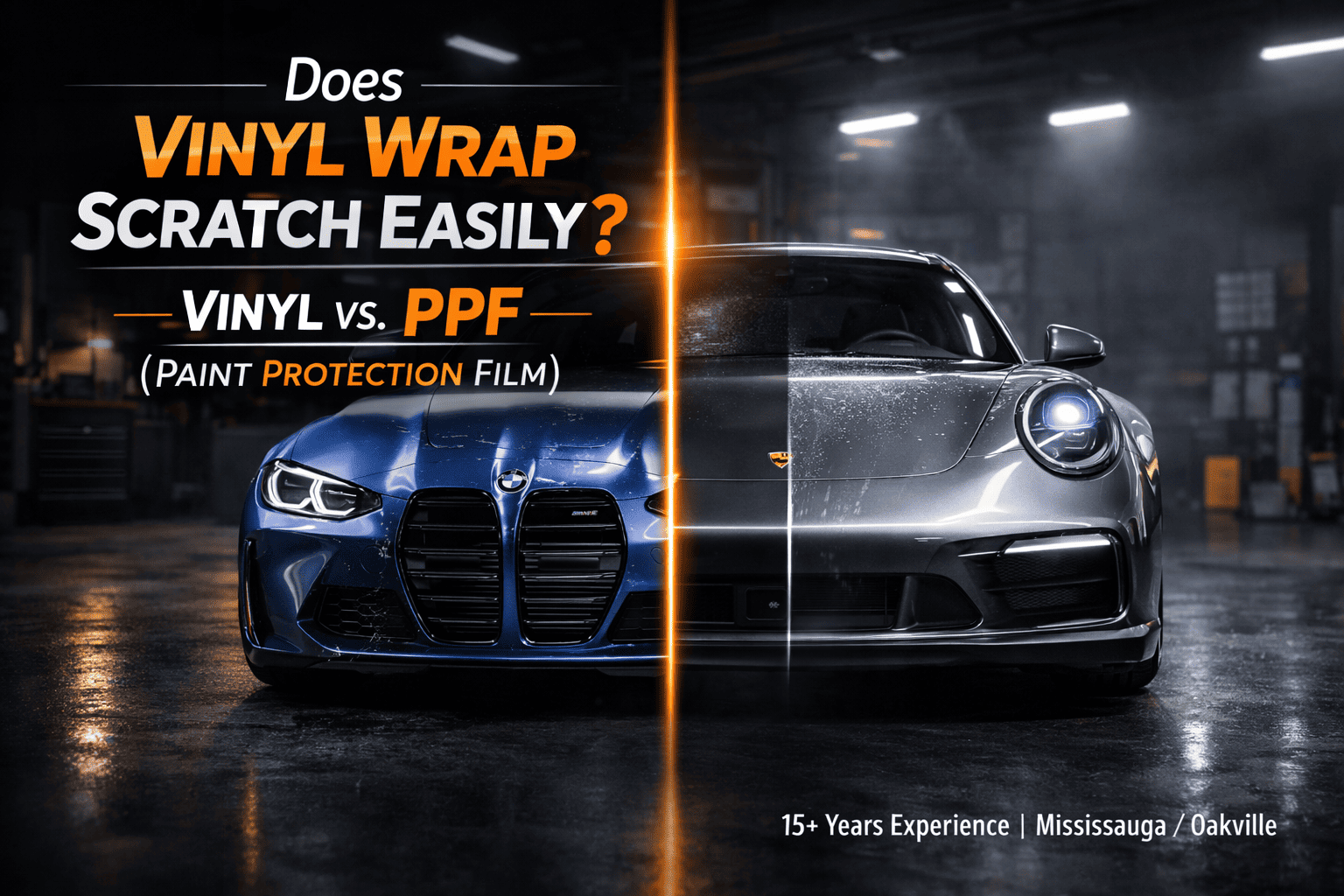
Does Vinyl Wrap Scratch Easily?
Vinyl can scratch or scuff, particularly when it is subjected to abrasive washing, dirty towels, brushes, branches, fingernails around handles, road debris or other physical contact.
How noticeable that damage becomes depends on several factors:
- The specific vinyl film
- The colour
- The finish
- The severity of the contact
- How the vehicle is washed
- How old the film is
- Environmental exposure
A light mark on a patterned or lighter-coloured wrap may be difficult to notice, while the same mark can be obvious on a dark gloss or specialty finish.
The important distinction is that vinyl is durable enough for automotive use, but it should not be confused with an impact-protection film.
What Is Automotive Vinyl Wrap Designed to Do?
Automotive wrap vinyl is a thin, flexible film designed to conform to painted vehicle panels.
Its main purposes include:
- Changing the vehicle’s colour
- Creating gloss, satin, matte and specialty finishes
- Adding stripes, accents or custom graphics
- Providing a reversible alternative to repainting
Because the vinyl covers the paint, it can also provide some protection from light surface contact and environmental exposure.
But that protection is a secondary benefit.
If you’re primarily considering a colour change, explore our car wrap options.
What Can Scratch a Vinyl Wrap?
Many of the marks we see on wrapped vehicles come from ordinary maintenance or contact rather than dramatic road impacts.
Automatic Brush Car Washes
Rotating brushes can drag dirt and abrasive particles across the vinyl, creating scratches and surface marring.
Repeated brush washing can be especially noticeable on gloss and dark-coloured wraps.
Dirty Microfiber Towels
Microfiber itself is generally safe when clean, but a towel containing sand, grit or hardened contamination can scratch vinyl just like it can scratch automotive clear coat.
Dry Wiping
Wiping dust or dirt from a dry wrapped surface can drag particles across the film.
Whenever possible, properly wash or lubricate the surface before wiping contamination away.
Fingernails and High-Contact Areas
The areas behind door handles can accumulate light scratches because of repeated contact from fingernails, rings and keys.
Branches and Physical Contact
Bushes, tree branches, equipment, bags and other objects can leave scuffs or scratches if they drag across the film.
Road Debris
Small stones and gravel can chip or puncture vinyl because the material isn’t designed to absorb impacts in the same way PPF is.
Does Vinyl Wrap Protect the Paint Underneath?
Yes, within limits.
Vinyl creates a physical layer between the environment and the vehicle’s paint, so some minor surface contact reaches the vinyl instead of the clear coat underneath.
It can help reduce exposure to:
- Light scuffs
- Minor surface abrasions
- Bug residue
- Bird droppings
- Tree sap
- Everyday environmental contamination
However, a force strong enough to cut, tear or puncture the vinyl may also reach the underlying paint.
That is why we don’t recommend buying a vinyl wrap primarily for stone-chip protection.
If you’re specifically concerned about whether wrapping affects the original finish, our guide to whether car wraps damage paint explains that relationship in more detail.
Vinyl Wrap vs PPF: Which Is More Scratch-Resistant?
PPF generally provides substantially more physical protection than colour-change vinyl because the two materials are engineered for different purposes.
| Feature | Vinyl Wrap | Paint Protection Film |
|---|---|---|
| Primary Purpose | Colour change and styling | Paint protection |
| Material | Automotive vinyl | Protective urethane film |
| Light Scuff Protection | Some | Stronger |
| Stone-Chip Protection | Limited | Designed specifically for it |
| Self-Healing Topcoat | Not a standard feature of most colour-change vinyl | Common on premium modern PPF |
| Colour Change | Excellent selection | Clear traditionally; coloured options increasingly available |
| Cost | Generally lower | Generally higher |
| Best For | Owners primarily wanting a different appearance | Owners primarily wanting physical paint protection |
If impact protection is your priority, see our Paint Protection Film options.
Why Does PPF Resist Damage Better?
The difference comes primarily from construction.
PPF uses a thicker, flexible urethane structure designed to absorb and distribute light impacts.
Premium modern PPF products often also incorporate a self-healing topcoat that can reduce the appearance of light surface scratches when exposed to warmth.
That doesn’t mean PPF cannot be damaged.
Deep scratches, severe stone impacts, tears and punctures can still penetrate the film.
The difference is that PPF is specifically engineered to take substantially more abuse than conventional colour-change vinyl.
Does Vinyl Wrap Self-Heal?
You should not assume it does.
This is one of the important differences between conventional vinyl wrap and modern PPF.
Some specialized vinyl products may have unique surface technologies, but self-healing should not be treated as a standard feature of automotive colour-change vinyl.
Heat may sometimes change the appearance of very light surface marks depending on the film, but applying heat is not a universal scratch-repair technique and excessive heat can damage vinyl.
If a scratch has cut through the film, the damaged vinyl does not simply heal itself.
Can a Scratched Vinyl Wrap Be Repaired?
It depends on the damage.
Very Light Surface Marks
Some marks may simply be contamination or transfer sitting on the surface rather than actual film damage.
These may come off with appropriate vinyl-safe cleaning.
Visible Scratches
If the surface of the vinyl itself has been scratched, polishing or heating it aggressively can create more problems, particularly with matte, satin or textured films.
The appropriate treatment depends on the exact material.
Deep Scratches or Tears
If the film has been cut or torn, replacement is usually the proper repair.
One advantage of a wrap is that an individual panel can often be rewrapped instead of replacing the entire vehicle wrap.
However, colour matching should be considered on older installations because a newly installed panel can occasionally look slightly different from film that has experienced several years of environmental exposure.
Does Wrap Finish Affect How Scratches Look?
Yes, although there isn’t a universal rule that one finish always hides scratches better than another.
Gloss Vinyl
Gloss films reflect light strongly, which can make fine scratches or wash marks visible under direct lighting, particularly on dark colours.
Matte Vinyl
Matte finishes diffuse light differently. Certain marks may be less reflective, but rubbing, polishing or abrasion can create shiny areas that contrast noticeably with the surrounding matte surface.
Satin Vinyl
Satin falls between gloss and matte and has its own maintenance considerations. Surface marks can become visible depending on colour and lighting.
Chrome and Specialty Films
Specialty films can be more sensitive to handling and surface damage depending on the product.
The correct maintenance procedure should always follow the film manufacturer’s instructions.
Does Higher-Quality Vinyl Scratch Less?
Film quality matters, but it doesn’t make the material scratch-proof.
We primarily use established automotive wrap manufacturers such as 3M and KPMF because installation characteristics, dimensional stability, adhesive performance, finish quality and manufacturer support all matter over the life of a wrap.
Premium film also gives the installer a known automotive product designed for vehicle use rather than an unknown material with unpredictable adhesive and durability characteristics.
But even premium vinyl can be scratched by improper washing or physical contact.
What About Vinyl Thickness?
You’ll often see vinyl and PPF compared based purely on thickness.
PPF is generally substantially thicker than colour-change vinyl, but thickness alone does not tell the entire story.
Material chemistry and intended use matter too.
Vinyl needs to be thin and conformable enough to stretch around body panels while maintaining a high-quality cosmetic finish.
PPF is engineered specifically to absorb impacts and protect paint.
That’s why comparing the two solely by a millimetre or mil measurement can be misleading.
Does Vinyl Protect Against Stone Chips?
Only to a limited extent.
A vinyl layer may take the surface contact from very minor debris, but it shouldn’t be relied upon to stop the same impacts PPF is designed to absorb.
A sharp stone can:
- Cut the vinyl
- Puncture the film
- Damage the paint beneath it
Drivers who spend substantial time on highways or simply want stronger front-end protection should consider PPF instead.
Can You Put PPF Over a Vinyl Wrap?
It can be done in some applications, but it isn’t automatically the best solution.
Compatibility between the specific vinyl, PPF and adhesive systems needs to be considered, and later removal becomes more complicated because two separate film layers are involved.
If you want an entirely different vehicle colour and PPF-level impact protection, there is now another option.
Coloured PPF Combines the Two Goals
Coloured PPF fills the gap between traditional vinyl wrap and clear PPF.
It can completely change the colour of the vehicle while using protective urethane film designed to provide meaningful stone-chip and road-debris protection.
That makes the choice easier to understand:
- Vinyl wrap: styling first
- Clear PPF: protection first
- Coloured PPF: colour change and protection together
If both goals matter to you, explore our coloured Paint Protection Film options.
Vinyl Wrap vs Coloured PPF
The availability of coloured PPF has changed the traditional vinyl-versus-PPF decision.
Previously, someone wanting a completely different colour generally chose vinyl. Now coloured PPF gives owners another route.
| Priority | Best Starting Point |
|---|---|
| Lowest-cost full colour transformation | Vinyl wrap |
| Largest colour and finish selection | Vinyl wrap |
| Keep factory colour but add impact protection | Clear PPF |
| Colour change plus substantial impact protection | Coloured PPF |
| Protect only high-impact areas | Clear PPF |
There isn’t one material that is universally better. The right choice depends on what you want the film to accomplish.
What About Ceramic Coating on a Vinyl Wrap?
A compatible ceramic coating can be applied over many vinyl wraps.
It can help with:
- Water behaviour
- Ease of washing
- Environmental contamination
- Keeping the surface cleaner
What ceramic coating does not do is transform vinyl into PPF.
It does not provide the same physical stone-chip protection as protective urethane film.
If you’re interested in easier maintenance, see our ceramic coating options.
How to Reduce Scratches on a Vinyl Wrap
The way you maintain the wrap has a major effect on its appearance.
- Wash gently. Use clean wash media and appropriate automotive soap.
- Avoid automatic brush washes. Repeated abrasive contact can create surface marks.
- Don’t dry-wipe dirty vinyl. Rinse or properly wash contamination away first.
- Use clean microfiber towels. Replace towels that have picked up grit.
- Remove bird droppings and sap promptly. Don’t let contamination sit unnecessarily.
- Be careful around matte and satin finishes. Avoid polishing products that may alter the surface sheen.
- Don’t pick at edges. Have lifting areas inspected instead.
How Long Will a Vinyl Wrap Stay Looking Good?
Scratch resistance is only one part of wrap longevity.
Film age is also affected by:
- Sun exposure
- Parking conditions
- Film quality
- Installation
- Vehicle orientation
- Maintenance
- Climate
If longevity is your main concern, read our guide to how long automotive vinyl wraps last.
Should You Choose Vinyl Wrap or PPF?
The easiest way to decide is to stop thinking of them as competing versions of the same product.
They aren’t.
Choose vinyl wrap if:
- Your main objective is changing the vehicle’s appearance
- You want access to a broad colour and finish selection
- You want a reversible alternative to repainting
- You accept that the film provides only limited impact protection
Choose PPF if:
- Your main objective is protecting factory paint
- Stone chips concern you
- You frequently drive on highways
- You want stronger protection on high-impact areas
- You want the original vehicle colour to remain visible
Consider coloured PPF if:
- You want a completely different colour
- You also want PPF-level physical protection
- You are comfortable with the higher cost compared with traditional vinyl
Frequently Asked Questions
Can vinyl wrap be scratched?
Yes. Automotive vinyl is durable but not scratch-proof. Improper washing, branches, tools, road debris and other physical contact can mark or damage the film.
Does vinyl wrap protect against scratches?
It provides a sacrificial layer that can take some light surface contact before it reaches the paint. However, it isn’t designed to provide the same scratch and impact resistance as PPF.
Does PPF scratch?
Yes. PPF can also be scratched. Many premium PPF products use self-healing topcoats that can reduce the appearance of light surface scratches, but deep damage can still penetrate the film.
Can scratched vinyl be polished?
It depends on the exact film and finish. Aggressive polishing can damage vinyl or alter matte and satin surfaces. Follow the manufacturer’s recommendations or have the film inspected before trying to correct a visible scratch.
Will a rock chip go through vinyl wrap?
It can. Vinyl isn’t designed as dedicated stone-chip protection, so sufficiently strong or sharp impacts can puncture both the film and underlying paint.
Is PPF better than vinyl wrap?
Only if physical protection is the priority. Vinyl is generally the better product for economical colour customization, while PPF is designed specifically for paint protection.
Final Thoughts: Vinyl Wrap vs PPF
Vinyl wrap doesn’t need to be fragile to have limitations.
A properly installed premium wrap can handle everyday automotive use while transforming the appearance of the vehicle. But it remains a styling product first.
PPF is the stronger choice when protecting against stone chips, scratches and road debris is the priority.
And if you want both a new colour and stronger physical protection, coloured PPF gives you an increasingly practical third option.
At It’s aWrap™, we install all three, so the recommendation depends on what you actually want from the film rather than trying to make one material do everything.
Explore our car wrap services, compare our Paint Protection Film options, browse completed vehicles in our portfolio, or contact It’s aWrap™ for help choosing the right material for your vehicle.