
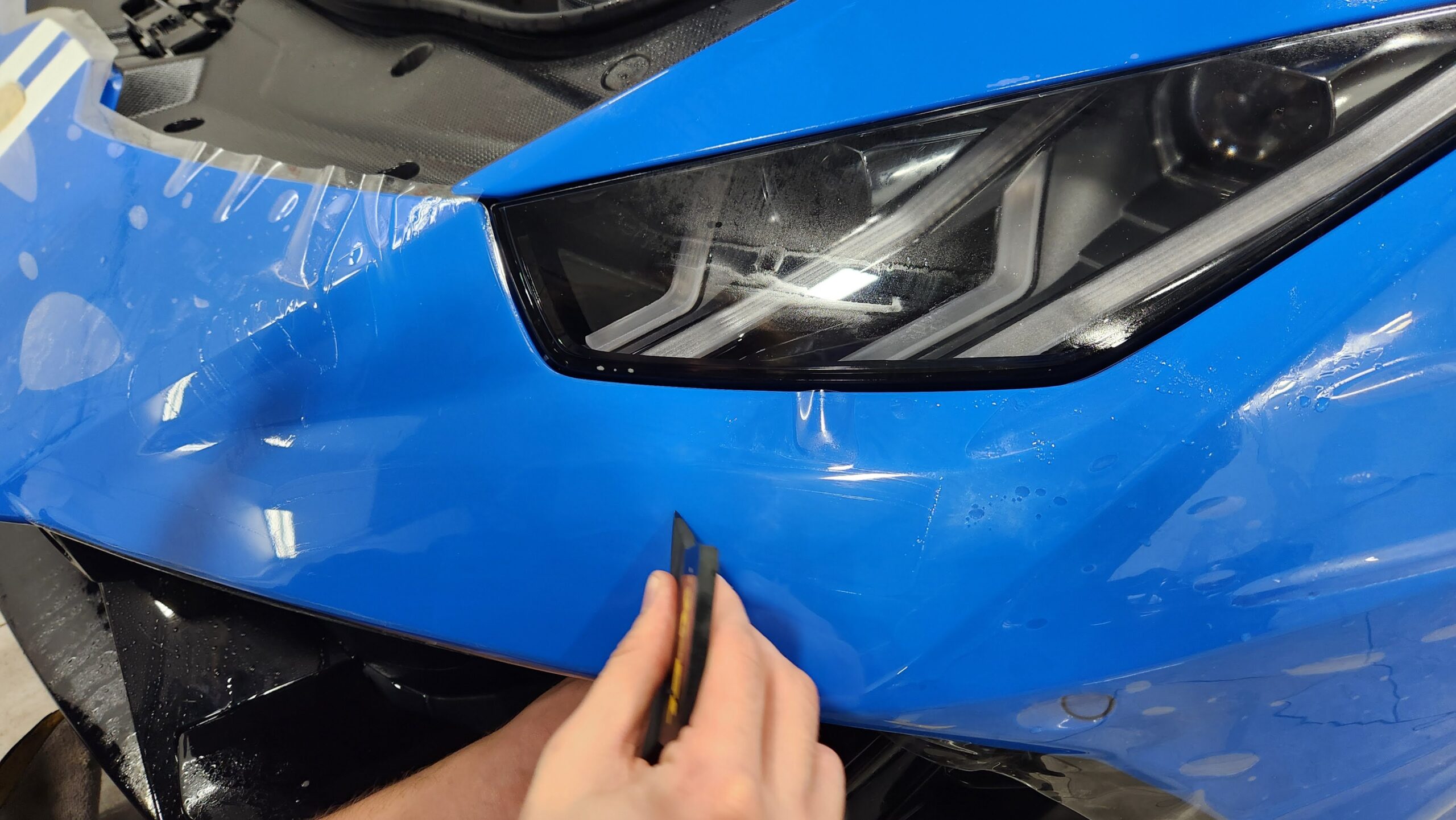
That can be unsettling when you have just paid to protect a new or carefully maintained vehicle, but some temporary visual changes are part of the wet-installation process. The important question is not whether you can see anything at all beneath the film. It is whether what you are seeing behaves like normal curing or something that needs installer attention.
At It’s aWrap™, we ask customers not to touch the film, press bubbles, manipulate edges or wash the vehicle during the initial post-installation period. Every PPF installation also comes back for our standard two-week inspection, which gives the film time to settle and gives us an opportunity to address anything that needs professional attention.
Why Fresh PPF Does Not Always Look Completely Settled
PPF is installed using an application solution that allows the installer to position the film accurately over the panel before the adhesive takes hold. Most of that liquid is removed during installation with a squeegee, but microscopic amounts of moisture can remain beneath the film afterward.
As that moisture works its way out and the adhesive stabilizes, the appearance can change. A patch that looks slightly cloudy on pickup day may become clearer. A small moisture pocket may shrink and disappear. Areas around compound curves or complex body lines may also take more time to settle than a large, flat section of hood.
Temperature plays a role as well. Warm, dry conditions generally help residual moisture move out more quickly, while colder or more humid weather can slow the process. That is one reason it is difficult to give every vehicle an exact number of days for complete curing. Film type, panel shape, weather and the amount of residual installation moisture all matter.
This curing period should not be confused with poor workmanship. The installer’s job is to remove as much solution as practical, set the film properly and inspect the finish before delivery. The remaining settling process continues after the vehicle leaves the shop.
Moisture Pockets and Air Bubbles Are Not the Same Thing
From outside the vehicle, a small pocket beneath PPF can simply look like a bubble. What is inside that pocket matters.
A residual moisture pocket often has a soft or slightly hazy appearance and changes as the film dries. The shape may become smaller, less visible or disappear altogether over time. This is different from a true trapped-air pocket, which can have a cleaner, sharper outline and may remain unchanged rather than gradually settling.
There is also a third possibility: contamination. A small piece of dust or debris trapped beneath the film can create a raised point with a visible particle at its centre. Unlike installation moisture, contamination does not evaporate.
This is why we do not recommend diagnosing every mark by touching it. Pressing on the film can move the adhesive, create a crease, mark the top coat or turn a minor issue into a more difficult repair. A trained installer can usually tell much more by inspecting the shape, location and behaviour of the area than by having the owner push on it.
Haze Can Be Part of the Same Curing Process
Some freshly installed film can look slightly cloudy or hazy when viewed from certain angles or under strong lighting. In many cases, what you are seeing is residual moisture between the adhesive and the paint rather than a permanent change in the clarity of the film.
The appearance should generally improve as the film settles. That is different from a persistent defect that stays unchanged after the normal curing period or from widespread cloudiness that does not improve at all.
It is also worth judging the vehicle under more than one type of lighting. Bright overhead shop lights, direct sun and shaded outdoor light can make the same section of clear film look noticeably different. The goal is not to ignore a real issue, but to give fresh film enough time to reach its settled appearance before assuming that every temporary mark is permanent.
The Best Thing You Can Do During the First Two Weeks Is Leave the Film Alone
This is where well-intentioned owners can cause more trouble than the original moisture pocket ever would.
Do not try to push a bubble toward the edge with your finger. Do not use a credit card or household squeegee. Do not puncture the film with a needle. Do not apply a heat gun or hair dryer because you found a repair technique online. Professional PPF is designed to be manipulated with specific installation techniques, and there is very little upside to experimenting on a finished panel.
At It’s aWrap™, our instruction is straightforward: do not touch the bubbles or edges and do not wash the vehicle before the scheduled two-week inspection. If you notice something during that period, leave it in place so we can evaluate what the film is actually doing when the vehicle returns.
This also gives us a better basis for deciding whether an area simply needed more curing time or actually requires adjustment. Correcting film too early can sometimes mean disturbing an area that would have settled naturally on its own.
If a section is actively peeling back, catching air while driving or showing a much larger problem than a small moisture pocket, contact the shop rather than attempting to secure it yourself. Otherwise, the scheduled inspection is the right time for us to evaluate the installation properly.
What We Look for at the Two-Week Inspection
The post-install inspection is not just a quick look at whether the film is still on the car. We are checking how the installation has settled after real-world temperature changes, driving and curing.
Areas that deserve attention include persistent pockets that have not improved, edges that have not remained properly seated, contamination that affects the finished appearance and any section where the film has not settled the way it should. We can also inspect complex areas around curves, panel edges, sensors, trim and other locations where the film has to work harder than it does across a flat panel.
The distinction between curing and workmanship becomes much clearer after the film has had reasonable time to settle. If a genuine installation issue remains, that is when it should be corrected rather than asking the customer to live with it.
This type of quality control is especially important with clear film because good PPF is supposed to disappear visually. The protection should be noticeable when it takes an impact, not because you can see obvious installation defects across the vehicle.
Some Conditions Should Improve; Others Need an Installer
There is no useful rule that says every bubble is normal or every bubble is a defect. What matters is the type of imperfection and whether it is changing as the film cures.
Small areas of residual moisture, light haze and minor water pockets that gradually become less noticeable are consistent with a film that is still settling. A persistent piece of contamination, a sharply defined air pocket that does not change, a crease or an edge that continues lifting deserves a closer look.
The same applies to what installers sometimes call silvering—small light-coloured lines or marks that can appear where the adhesive has not made perfectly uniform contact with the surface. Some visual irregularities can improve as the adhesive settles, while others can reflect stress or installation technique. It is another example of something that is better assessed in person than diagnosed from a quick photo.
If you are unsure, take a photo so you can monitor whether the area is changing, but resist the urge to repair it yourself. The purpose of the follow-up inspection is to separate what is naturally resolving from what actually requires professional correction.
After the Initial Curing Period, Normal PPF Care Takes Over
Once the film has settled and the initial inspection is complete, the focus shifts from curing to long-term maintenance. PPF is designed to take the abuse that would otherwise reach the paint, but it still benefits from proper washing, careful drying and reasonable treatment around its edges.
Pressure washers should not be aimed aggressively into an exposed film edge, abrasive compounds should not be used casually and contamination such as bird droppings or bug residue should not be left indefinitely simply because the paint is protected underneath.
Our PPF care and maintenance guide covers the long-term routine in more detail. The important distinction is that those are ownership habits for film that has already settled; during the first two weeks, less intervention is usually better.
New PPF Needs Time—and Good Follow-Up
A good PPF installation is not judged only in the hour after the final squeegee pass. Wet-installed film needs time to stabilize, and small temporary changes in appearance can occur while that happens.
That does not mean every bubble should be dismissed as normal. It means the film should be given enough time to cure before temporary moisture is confused with a permanent problem. The installer should then stand behind the finished work and inspect anything that has not settled properly.
At It’s aWrap™, that is why we pair the installation with a two-week post-pickup inspection. Customers do not need to guess whether they should press a pocket, heat an edge or try to repair something themselves. Leave the film alone, let it settle and let us inspect the finished installation once it has had time to cure.
If you are considering PPF for your vehicle, learn more about our Paint Protection Film services in Mississauga. If you already have film installed and notice something that appears more serious than normal curing, contact It’s aWrap™ so we can review it properly.