
Most vehicle owners are familiar with Paint Protection Film (PPF), ceramic coatings and window tint. Windshield protection film is less common, but it has gained attention as another way to protect one of the most vulnerable—and sometimes surprisingly expensive—parts of a modern vehicle.
So, is windshield protection film actually worth it?
The answer depends heavily on the vehicle.
At It’s aWrap™, we don’t consider windshield protection film an automatic recommendation for every car. It can provide valuable protection against road debris and windshield damage, but it also comes with trade-offs that are important to understand before spending the money.
For an everyday commuter, there may be better places to invest your vehicle-protection budget first. For an exotic, collector car or vehicle with expensive specialty glass, the calculation can be completely different.
Here’s what you should know before deciding.
What Is Windshield Protection Film?
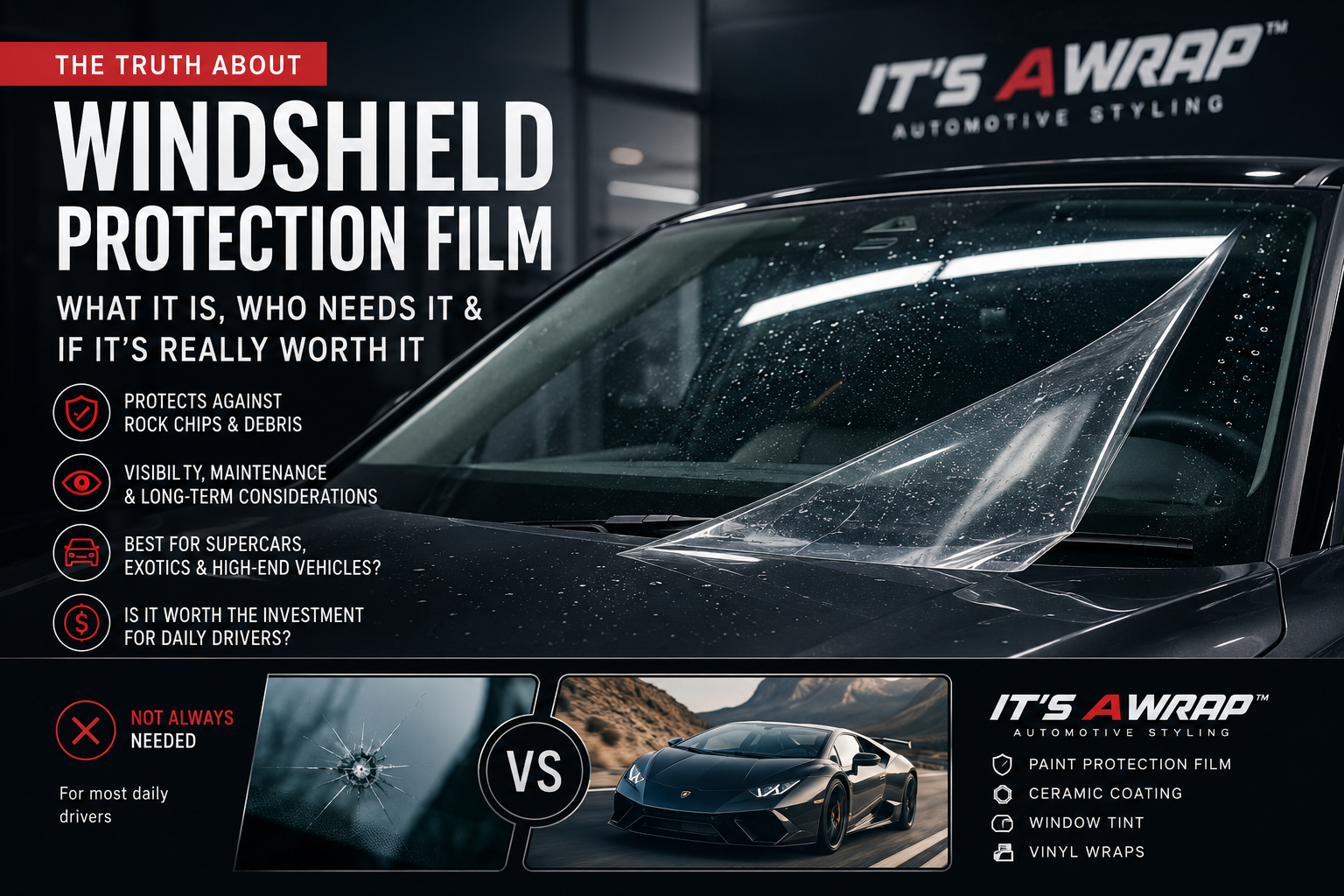
Windshield protection film is a transparent protective film installed on the exterior surface of a vehicle’s windshield. It acts as a sacrificial layer between the glass and the debris your vehicle encounters on the road.
The concept is similar to Paint Protection Film on painted body panels. Instead of a stone or piece of road debris striking the original surface directly, it hits the protective film first.
Depending on the product, impact and driving conditions, windshield protection film may help reduce damage from:
- Small rocks and road debris
- Surface pitting
- Sandblasting from highway driving
- Minor scratches and abrasions
- General windshield wear
However, windshield protection film should not be confused with an indestructible shield. A sufficiently hard or sharp impact can still damage the windshield underneath.
Its purpose is to reduce risk and absorb wear—not guarantee that your windshield can never crack or chip.
Why Windshield Protection Film Is Different From Regular PPF
This is one of the most important things to understand.
Paint Protection Film and windshield protection film may share a similar concept, but they operate under very different conditions.
Traditional PPF is installed on painted surfaces. You aren’t looking through your hood, bumper or fenders while driving.
Your windshield is different.
Every second you’re behind the wheel, you’re looking directly through the glass and the film covering it. That means optical clarity matters significantly more.
A minor imperfection that might go unnoticed on a bumper can become distracting when it sits directly in your field of vision.
That’s one reason opinions about windshield protection film can vary so much. Some owners consider the additional protection completely worthwhile. Others are more sensitive to changes in the surface or optical characteristics of the film as it ages.
What Does Windshield Protection Film Actually Protect Against?
The primary reason to install windshield protection film is to reduce the risk of damage from everyday road debris.
Ontario highways can expose windshields to loose stones, construction debris, road grit and winter contaminants. Highway driving is particularly relevant because even relatively small debris can strike the glass at considerable speed.
Modern windshields can also be much more complicated than they appear.
Depending on the vehicle, the windshield assembly may interact with equipment such as:
- Forward-facing cameras
- Lane-keeping and collision-avoidance systems
- Rain sensors
- Heads-up displays
- Heating elements
- Other Advanced Driver Assistance Systems (ADAS)
When replacement requires specialty glass, additional labour or recalibration of driver-assistance equipment, the final cost can be considerably higher than simply replacing a basic piece of automotive glass.
That’s where windshield protection film starts becoming much easier to justify.
The Biggest Trade-Off: Optical Clarity Over Time
If there is one disadvantage prospective buyers should understand before installing windshield protection film, it’s this.
The film lives in an extremely demanding environment.
Unlike PPF installed on a hood or bumper, windshield film regularly encounters:
- Windshield wipers
- Dust and road grit
- Rain and snow
- Road salt
- Washer fluid
- Ice and winter contamination
- Highway debris
A quality film can have excellent optical clarity when properly installed, but the surface will inevitably experience wear as it does its job.
Fine scratches, contamination and surface wear may eventually become more noticeable—particularly to drivers who are very sensitive to windshield clarity.
This doesn’t necessarily mean the film has failed.
In fact, some of that wear is evidence of the sacrificial layer doing exactly what it was installed to do. The film is taking abuse that would otherwise be reaching the windshield itself.
The trade-off is that windshield protection film may eventually require replacement if maintaining excellent clarity is a priority.
Is Windshield Protection Film Worth It for a Daily Driver?
For many ordinary daily drivers, it wouldn’t be our first protection upgrade.
That’s not because windshield protection film doesn’t work. It’s because value depends on what you’re protecting and how the vehicle is used.
Consider a car driven year-round through Mississauga and the GTA. It may see winter road salt, snow and ice, highway construction, frequent windshield-wiper use and tens of thousands of kilometres each year.
That environment puts substantial wear on the protective film itself.
If the vehicle has a relatively conventional windshield that can be replaced without extraordinary cost or difficulty, periodically replacing windshield film may not offer the strongest return on your protection budget.
For many daily drivers, we’d generally prioritize:
- PPF on high-impact painted areas
- Quality window tint for heat, UV and comfort
- Ceramic coating for easier maintenance and surface protection
If you’re deciding how to allocate a limited protection budget, our guide to the highest-impact areas to protect with PPF is a useful place to start.
When Windshield Protection Film Makes Much More Sense
There are vehicles where the equation changes considerably.
We would give windshield protection film much stronger consideration for:
- Supercars and exotic vehicles
- Collector and rare vehicles
- High-end luxury vehicles with expensive glass
- Track-focused or enthusiast vehicles
- Vehicles with limited replacement-glass availability
- Vehicles where windshield replacement requires costly calibration or specialty components
On these vehicles, windshield replacement isn’t always a routine inconvenience.
The cost of the glass itself may be significant. Parts availability can complicate the repair. Cameras or other driver-assistance systems may need to be recalibrated after replacement.
If replacing the windshield could become a substantial repair, paying to place a sacrificial protective layer over the original glass becomes easier to justify.
Why Supercar and Exotic Owners Often See More Value
A Ferrari, Lamborghini, McLaren or limited-production performance vehicle generally isn’t used the same way as an ordinary commuter.
These vehicles may accumulate fewer annual kilometres, but those kilometres can include highway cruises, rallies, enthusiast events and spirited drives where road debris is a genuine concern.
The replacement parts can also be more expensive and less readily available.
For these owners, windshield protection film often becomes part of a broader preservation strategy.
It’s the same reason many exotic owners choose full-body PPF rather than protecting only the front bumper and hood.
The objective isn’t to make the vehicle immune to damage. No protective film can do that.
The objective is to reduce the likelihood that ordinary road exposure turns into an expensive repair.
What About Windshield Protection Film for Teslas?
Tesla owners frequently invest heavily in vehicle protection, so windshield film naturally comes up in the conversation.
Whether it makes sense depends on your priorities and how the vehicle is driven.
A Tesla that spends significant time commuting on Ontario highways will expose windshield film to considerably more wear than a weekend vehicle. Before adding windshield protection, many owners may get greater day-to-day value by first addressing high-impact painted areas.
For example, we’ve covered why Tesla paint can be vulnerable to chips during Canadian driving and how different PPF coverage options can address those areas.
Windshield protection can then be considered as an additional layer within a broader protection package rather than automatically being the first upgrade.
Windshield Protection Film vs. Replacing the Windshield
This is ultimately the financial question worth asking.
Don’t simply ask:
“How much does windshield protection film cost?”
Ask:
“What would replacing my particular windshield cost, and how difficult would that replacement be?”
If replacement glass is readily available and relatively affordable, the financial argument for repeatedly protecting it becomes weaker.
If the windshield is expensive, difficult to source, integrated with sophisticated technology or installed on a rare vehicle, protection becomes much more attractive.
This is why we don’t believe there is a universal answer to whether windshield protection film is “worth it.”
Pros and Cons of Windshield Protection Film
| Advantages | Considerations |
|---|---|
| Helps reduce damage from smaller road debris | Cannot prevent every chip or crack |
| Creates a sacrificial barrier over expensive glass | Surface wear can affect clarity over time |
| Can reduce pitting and sandblasting | May eventually require replacement |
| Potentially valuable for expensive or rare windshields | May offer less value on inexpensive daily drivers |
| Can complement a complete vehicle-protection package | Cost should be weighed against actual windshield replacement cost |
So, Do You Really Need Windshield Protection Film?
For the average daily driver?
Probably not.
For many commuters, we’d prioritize protection that provides a more noticeable everyday benefit or protects the painted areas most frequently damaged by road debris.
For an exotic, collector vehicle, specialty performance car or vehicle with an unusually expensive windshield?
It’s worth serious consideration.
The important distinction is that windshield protection film isn’t inherently a good or bad investment. Its value depends on the cost and difficulty of the damage you’re trying to prevent.
Our Recommendation
At It’s aWrap™, we believe vehicle protection should match the vehicle, how it’s driven and what the owner is actually trying to preserve.
We don’t recommend adding every available protection product simply because it exists.
For most daily drivers, we’d generally start with professional Paint Protection Film on vulnerable painted surfaces and then consider other products according to the owner’s priorities.
For supercars, exotics, collector vehicles and vehicles with particularly expensive or difficult-to-replace glass, windshield protection film can make considerably more sense as part of a complete protection strategy.
The key is understanding the trade-off before installation: you’re adding a replaceable protective surface to preserve a much more expensive permanent one.
Frequently Asked Questions About Windshield Protection Film
Does windshield protection film prevent rock chips?
It can help reduce damage from smaller rocks and road debris by creating a sacrificial layer over the windshield. However, no windshield film can guarantee protection against every impact, and sufficiently severe impacts can still chip or crack the glass.
Does windshield protection film affect visibility?
A quality windshield protection film should provide strong optical clarity when properly installed. Because the film sits on the exterior and is exposed to wipers, dirt, road grit and weather, surface wear can develop over time and may eventually become noticeable.
How long does windshield protection film last?
There isn’t one lifespan that applies to every vehicle. Longevity depends heavily on kilometres driven, highway exposure, windshield-wiper use, winter conditions, maintenance and the specific film installed. A frequently driven Ontario commuter can put substantially more wear on the film than an occasionally driven collector vehicle.
Can windshield protection film stop a windshield from cracking?
It can help absorb some smaller impacts, but it cannot make automotive glass unbreakable. A large enough stone or sufficiently severe impact can still damage the windshield.
Is windshield protection film worth it?
It can be particularly worthwhile for exotic, collector and luxury vehicles with expensive or difficult-to-replace windshields. For an average daily driver with relatively affordable replacement glass, other forms of vehicle protection may provide better overall value.
Is windshield protection film the same as Paint Protection Film?
No. Although the underlying idea is similar, windshield protection film is designed for exterior automotive glass where optical clarity is critical. Traditional PPF is designed primarily to protect painted vehicle surfaces.
What vehicle protection should I prioritize first?
For most drivers, protecting high-impact painted surfaces with PPF is a strong starting point. Window tint and ceramic coating can then address different needs such as cabin comfort, UV rejection and easier exterior maintenance. Windshield protection becomes more compelling when the vehicle’s replacement glass carries substantial cost or complexity.
Considering Windshield Protection Film in Mississauga?
If you’re unsure whether windshield protection film makes financial sense for your vehicle, contact It’s aWrap. We can help you compare the protection options based on your vehicle, how you drive it and where your budget will have the greatest impact.